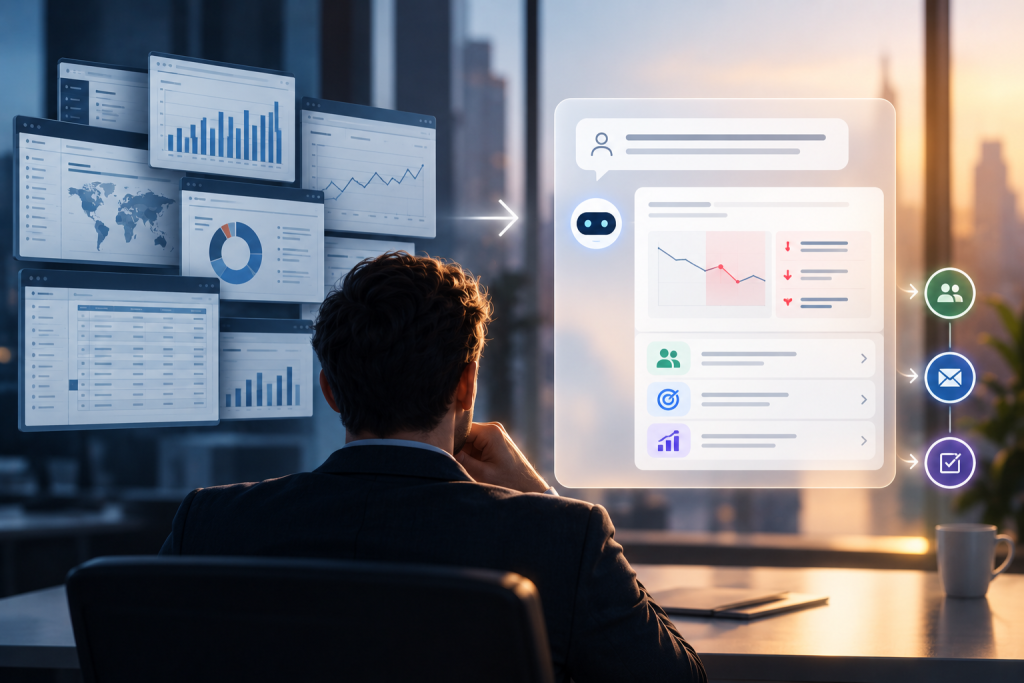
For decades, we have asked people to navigate dashboards to find answers in data. AI is beginning to reverse that relationship.
For the past twenty years, self-service analytics has meant giving business users dashboards and expecting them to find their own answers. Find the right dashboard, understand the metrics, apply the right filters, notice the anomaly, drill into it and decide what to do next. AI changes that interaction. Imagine a sales executive whose revenue is suddenly 8% below plan.
Instead of navigating several dashboards, the executive asks: “Why are we 8% below plan, and what should I pay attention to?”
An analytics agent can investigate the underlying data, identify the customer segments responsible, determine whether price or volume is driving the decline and surface the accounts that deserve attention. The user can continue: “Is this normal seasonality?” and then “Which accounts should sales contact first?”
The important change is not that AI produces a chart faster. The user no longer needs to know which chart to look at.
The real disruption happens after the insight
This does not mean dashboards disappear.
They remain useful for persistent monitoring, visual pattern recognition and shared views of important metrics.
A CFO may still want revenue, margin and cash displayed every morning without having to ask for them.
But dashboards traditionally stop at insight: they show that something happened and leave humans to investigate, decide and act.
Analytics agents can begin to compress that chain by investigating causes, bringing in relevant context, recommending an action and potentially initiating the workflow required to execute it.
The interaction moves from “Why is revenue down?” toward “Which customers are driving the decline, which ones should we contact, and what should we do next?”
At that point, the dashboard is no longer the destination. The decision is.
That also changes what self-service means.
Instead of giving more people tools to perform analytics themselves, AI may allow people to perform less of the analysis while placing greater value on their ability to ask useful questions, challenge the answer and decide what action makes business sense.
The interface is moving closer to the decision
The opportunity is not to replace every dashboard with a chatbot. It is to start with the business questions that still require too much navigation, manual analysis or support from analysts.
Why did margins fall last week? Which customers are most likely to miss their forecast? What caused the increase in delivery failures?
Answering these questions requires more than access to data. It requires consistent metric definitions, business rules, context and human judgment to turn information into reliable conclusions.
As AI takes on more of the analytical work, these foundations become even more important. A fluent, convincing answer is of little value if it is built on inconsistent definitions or incomplete context.
This does not mean dashboards will disappear. They remain valuable for continuous monitoring, tracking performance and comparing trends. AI agents serve a different purpose: investigating what happened, connecting the dots and helping people determine what to do next.
For decades, analytics required people to navigate data through predefined structures and interfaces. AI offers a different starting point: the business question itself.
The dashboard showed us what happened. The next generation of analytics will be judged by how well it helps us decide what to do next.